It was brought to my attention by our Public Programs Manager, Carl Hildebrand that Norwegians celebrate Nasjonaldagen on May 17. Nasjonaldagen commemorates the signing of the Constitution of Norway at Eidsvoll in 1814 that declared the country’s status as an independent nation. To mark the occasion, I have decided to devote today’s blog post to an exploration of Norwegian materials in the Wolfsonian-FIU collection.
The Wolfsonian library possesses a number of works featuring the work of Norwegian painter and illustrator, Gerhard Munthe (1849-1929). A catalog of furniture in the modern style exhibited at the Exposition Universelle de 1900 in Paris, for example, includes a plate with panels designed by the artist to represent Norway at that international exposition.
Also included in the library is a book of Norse mythology and nationalistic Norwegian folk-songs illustrated by Munthe and published posthumously in 1933.
One of Munthe’s designs celebrating Norway’s Norse heritage and folk traditions was also artistically woven into the fabric of a tapestry put into production in the 1920s and 1930s by the Nordenfjeldske Kunstindustrimuseum Tapestry Studio. The woolen tapestry, titled The Daughters of the Northern Lights (Aurora Borealis) depicts a scene loosely based on Norse legends and mythology in which three polar bears approaching three female figures with stylized flame-like blonde hair.
Norway’s Viking heritage and folk-song traditions were also celebrated at another world’s fair, the Alaska-Yukon-Pacific Exposition held in Seattle, Washington in 1909. The Wolfsonian library possess a rare copy of an original program from that fair promoting Norway Day Festivals.
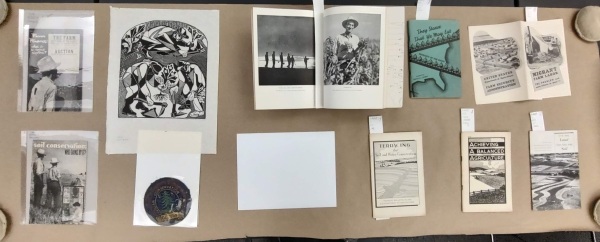
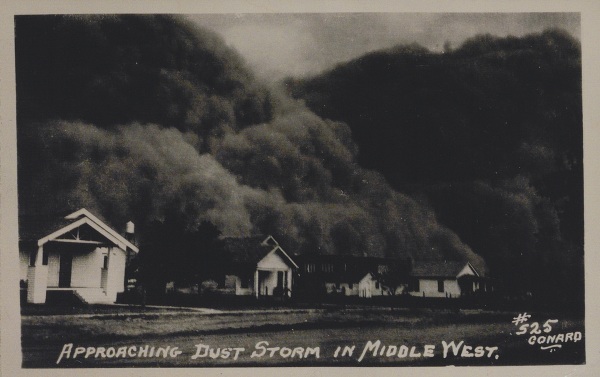
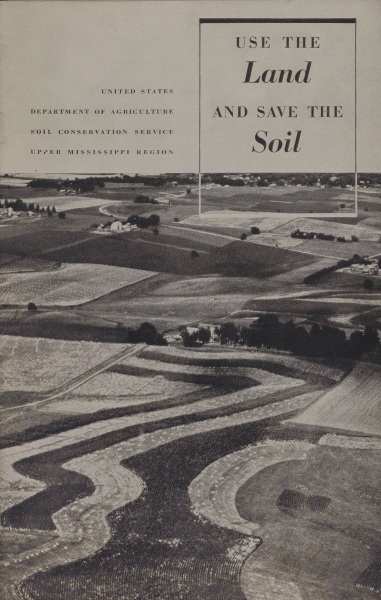
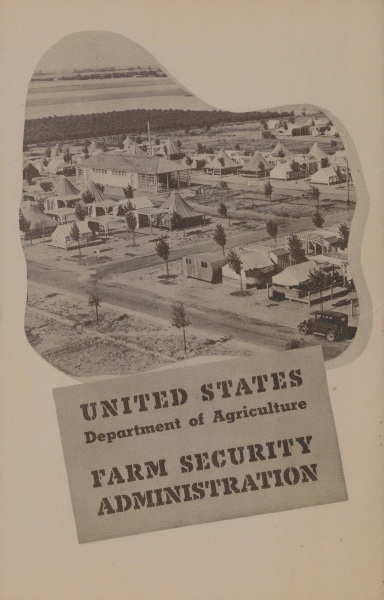
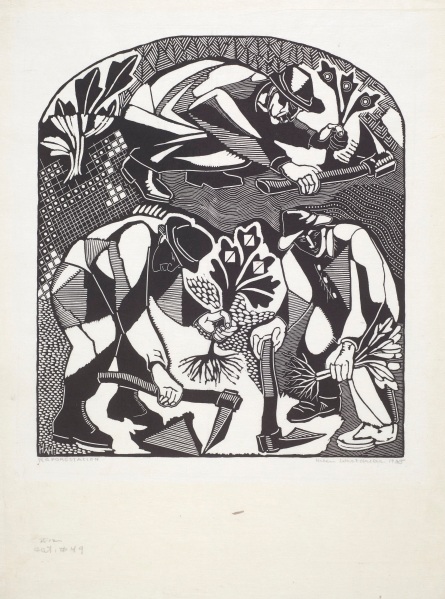
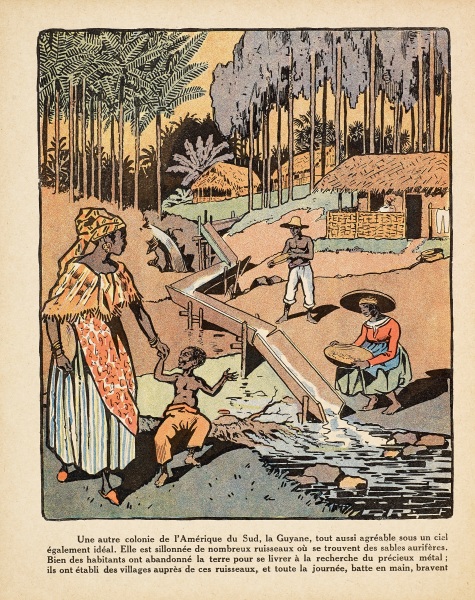
Norway participated in the New York World’s Fair in 1939, and the library holds several pamphlets distributed at their pavilion promoting Norwegian agriculture (first image in today’s post) and the cod liver oil industry.
Although New York World’s Fair promoters intended to celebrate the peaceful achievements to be enjoyed in the “world of tomorrow,” war clouds gathering in Europe ushered in a very different reality. On April 9, 1940, the Germany Wehrmacht invaded and occupied Norway, installed a pro-German puppet regime as the Norwegian King and cabinet went into exile in London. During the occupation, the Nazi attempted to forge a united Nordic front with propaganda posters appealing to Norway’s Norseman heritage.
In the United States, the American poet Joseph Auslander (1897-1965) worked with various artists (including Stevan Dohanos, 1907-1994), to counter such pernicious propaganda with a series of illustrated open letters to the “unconquerable” peoples of the occupied territories.
Other material in the Wolfsonian library collection pertaining to Norway includes such items as this brochure promoting air travel in Norway.
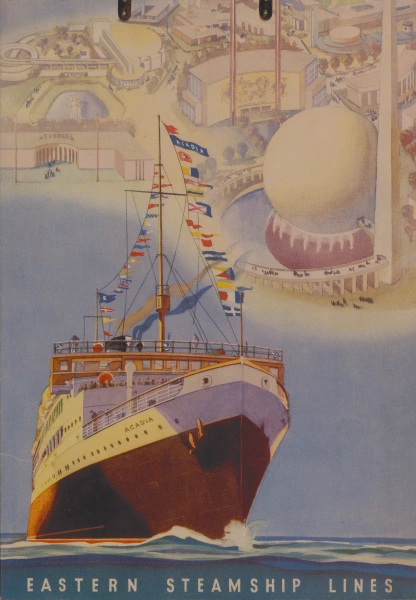
The majority of our Norwegian materials, however, relate to travel by ship and include numerous brochures.
Thanks to the generosity of ocean liner aficionado Laurence Miller, the library also possesses a fine collection of printed promotional materials from the post-World War II period.
GIFTS OF LAURENCE MILLER
Since we began this blog with a textile depiction of the Aurora Borealis, I thought that I would share the following video clip of the same provided courtesy of Norwegian Coastal Cruises.
With so much talk lately in the news about possible chemical weapons use in Syria, crossing “red lines,” and crimes against humanity, it seemed appropriate to explore such issues in their historical context. And there is hardly a better place (and collection) to do that with than that of the Wolfsonian-Florida International University.
While the controversy has raged as to whether or not the Syrian government has stooped to a new low in its war against its own population by using chemical weapons against the resistance fighters, I have been haunted by an image from our own collection in an apparent echo from another civil war. The cover illustration of Flecha, a periodical published by the Delegación Nacional de Prensa y Propaganda de F.E.R. y de las J.O.N.S. during the Spanish Civil War is an especially chilling one, but not because of any gruesome graphics of civilians killed by chemicals. Rather it is because the Fascists used images of adorable blonde children playing at war to sell the idea to children that the use of such weapons was perfectly rational—as normal, in fact, as using insecticide to kill bugs and other vermin.
PROMISED GIFT OF MITCHELL WOLFSON, JR.
In the course (and aftermath) of that bloody civil war, it has been estimated that close to 38,000 persons were executed during the “red terror” while another 110-150,000 died at the hands of Francisco Franco’s fascist forces. There were also reports, (though unconfirmed), that chemical and biological weapons were used during the Spanish Civil War—a possibility that doesn’t appear so far-fetched given that Spain was one of the first European powers to use chemical weapons against a civilian population in the aftermath of the First World War. During the Riffian Berber rebellion in Morocco, some 13,000 Spanish and colonial troops were killed in battle at Annual on July 22, 1921 by indigenous warriors fighting with Abd-El-Krim.
Translation: “1921: Abd-El-Krim defeats the Spanish Army, and thus ends in the African Protectorate the disgraceful exploitation of the workers and the traffic in soldiers’ lives.”
Following that embarrassing and crushing defeat, Spanish Moroccan High Commissioner Dámaso Berenguer telegraphed the Minister of War expressing a change of heart, noting that “I have been obstinately resistant to the use of suffocating gases against these indigenous peoples but after what they have done, and of their treasonous and deceptive conduct, I have to use them with true joy.” The following month, Spain asked Germany—prohibited from manufacturing chemical weapons by the Treaty of Versailles ending WWI—to send or help them produce mustard gas. With the assistance of German chemist Hugo Stolzenberg, mustard gas deliveries were made in 1923, and by 1924 the chemical was being manufactured at the Fabrica Nacional de Productos Quimicos plant at La Marañosa near Madrid and used in aerial attacks against Moroccan civilians, markets, and watering-holes. Although a year later, the League of Nations enacted the Geneva Protocol calling for the “Prohibition of the Use in War of Asphyxiating, Poisonous or other Gases, and of Bacterialogical Methods of Warfare,” Spain continued its indiscriminate use of such weapons in Morocco through 1927.
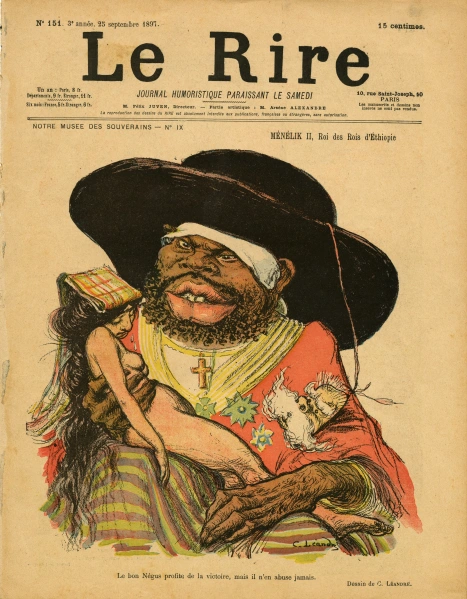
Italian Fascists were the next to openly acknowledge their use of chemical weapons in 1936 during their invasion, conquest, and colonization of Ethiopia, Africa’s last independent state. To justify their invasion and resort to chemical weapons, Italian propaganda depicted the East Africans as barbarous murderers of Christians, with one postcard referencing the “martyrdom” of Padre Reginaldo Giuliani in 1936.
Italian propagandists also made use of “war as child’s play” imagery strikingly similar to that used in the Spanish Civil War periodical.
GIFT OF STEVEN HELLER
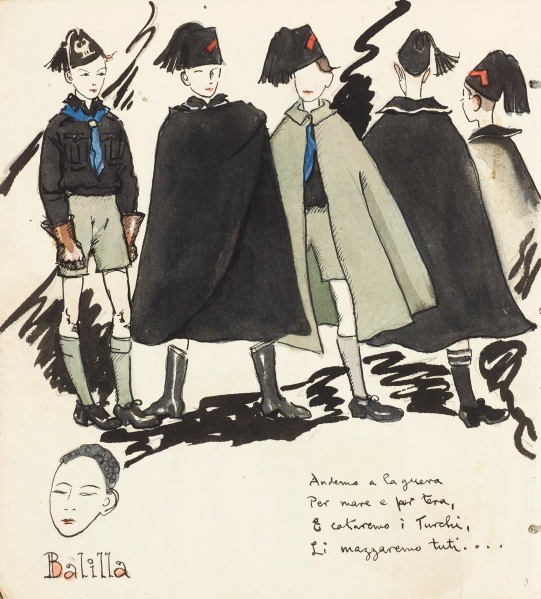
A series of postcards illustrated by Aurelio Bertiglia pictured Italian children in Balilla and colonial military uniforms “kicking ass” in Ethiopia, depicting bloodless victories and humanitarian acts of distributing food and liberating enslaved Africans.
GIFTS OF STEVEN HELLER
In the actual course of the Second Italo-Abyssinian War (1935-1937), however, the Italian air force was engaged in dropping mustard gas onto Ethiopian soldiers in blatant violation of the Geneva conventions. One can only hope that the lessons of the past may be heeded and that the terrible conflict in Syria not be made all the more horrific by the use of chemical weapons.
All of us have been affected by the tragic news reports concerning the hundreds of garment workers crushed to death after the collapse of an unsafe building in Bangladesh. The callousness with which these workers’ concerns about the structural integrity of the building were ignored, and the spotlight it has placed on sweatshop conditions in the industry has resulted in demonstrations and demands for reform.
Coupled with these news reports from Bangladesh, I have been perusing accounts and film footage filtering in on the Web of rioting, vandalism, and skirmishes between May Day “anarchists” and police in Seattle, Washington.
All of this got me to thinking yesterday on the history of the clothing workers and of the significance and meaning of the May Day “holiday.” It is easy—far too easy—for those of us living in the United States and buying clothing to ignore the plight of the workers involved in making those items when they are—for the most part–living a world away in what we refer to as the “Third World.” I am reminded of the lyrics of “One World (Not Three)”—a 1981 song by the Police in which Sting reminds us that “one world is enough for all of us,” and that “by pretending they’re a different world from me, I show my responsibility.”
It was not so very long ago that “sweatshop” working conditions in the garment industry in our own country were not so very different than those in Bangladesh, resulting in deadly industrial disasters like the Triangle Shirtwaist Factory fire in New York City. On March 25, 1911, a fire broke out in the building where a large number of Jewish and Italian immigrant women were working. The managers of that company had locked the stairwell doors and exists—a common practice to prevent women workers from taking unauthorized breaks—and as a result, 146 garment workers between the ages of fourteen and forty-three perished from fire, smoke inhalation, or from jumping from the eighth, ninth, and tenth floor windows of the building.
In the aftermath of that tragedy, some turned to music to memorialize the tragedy while others pushed for the passage of labor and workplace safety standards legislation to prevent similar events.
The horrific event also prompted the rise of the International Ladies’ Garment Workers’ Union (ILGWU) dedicated to fighting for better working conditions.
The ILGWU found a champion in Dale Zysman, Vice President of the Teachers’ Union and a militant Communist who habitually struck Stalinesque poses with his own pipe! In 1935 he published an account of the unionization of the garment industry attacking the Socialist and American Federation of Labor (AFL) trade unions as “reactionaries” and lauding Communist organizers as “heroes.”
GIFT OF FRANCIS XAVIER LUCA & CLARA HELENA PALACIO-DE LUCA
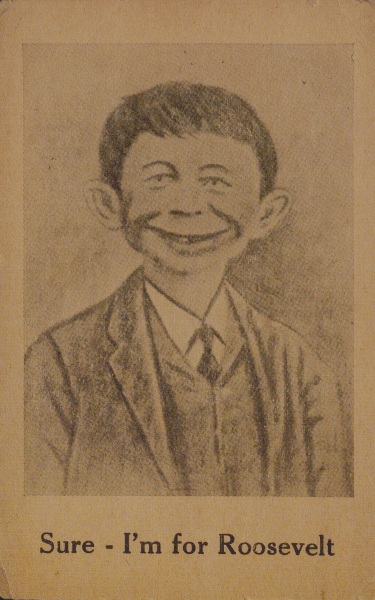
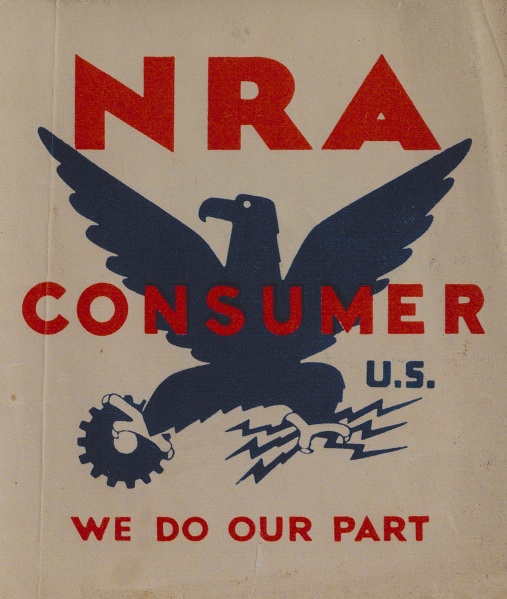
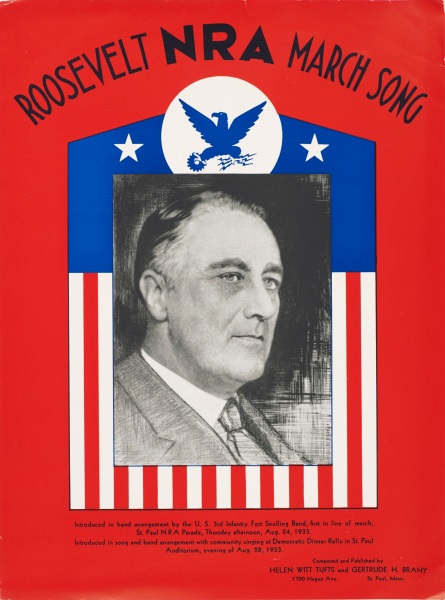
Of course, in spite of the gains made by some unions, sweatshop conditions did not disappear overnight. Some progress was made during the Great Depression under the auspices of the Roosevelt Administration. The passage of the Wagner Act (The National Labor Relations Act of 1935) did wonders for clothing workers across the nation, as is attested to by the “Write-a-letter-for-Roosevelt” contest sponsored by the Amalgamated Clothing Workers of America in 1940.
PROMISED GIFTS OF MITCHELL WOLFSON, JR.
Even on through the war years, unions continued to fight for better wages and working conditions for those persons employed in the clothing and textile industries.
One such pamphlet produced by the Textile Workers Union of America sought to remind the public that nearly half a million “forgotten” cotton textile workers were still enduring poor working conditions, were still inadequately paid, and still living in substandard housing.
Turning from the garment industry tragedy in Bangladesh to the May Day disturbances in Seattle, Washington, I was also drawn back to the Wolfsonian library collection and connections to the events in another American city, Chicago, which shaped the internationally recognized day of labor and the working class.
ILLUSTRATIONS BY ROCKWELL KENT (1882-1971)
In 1886, the AFL, the Knights of Labor, the Socialist Labor Party, and the Central Labor Union of Chicago, and other militant leftist organizations united behind the Eight Hour Association campaign for: “Eight hours of work, eight hours of sleep, and eight hours of recreation.” The various labor organizations decided to flex their collective muscle by calling all workers to pick a single day in which they would all stand shoulder to shoulder in a mass demonstration of worker solidarity.
More than 20,000 workers attended the pre-May Day mobilization, and on May 1st the city of Chicago work stopped as the working class lay down their tools of their various trades and joined peaceful demonstrations in the streets. Two days later, however, violence erupted at a mass meeting at the aptly named McCormick Reaper Works when the police attacked and killed six of the striking workers. On May 3rd, outraged citizens again took to the streets, assembling in Haymarket Square to demonstrate against the previous day’s police violence.
During that demonstration, a makeshift bomb was thrown and the police responded by firing into the crowd, killing and wounding several other policemen and demonstrators.
Although the assailant was never identified, several organizing labor leaders were tried as instigators of the riot. Although none of them were guilty of throwing the bomb, four of the “radicals” were convicted of conspiracy and inciting riot and were condemned to death: Adolph Fischer (1858–1887), George Engel (1836-1887), Albert Richard Parsons (1848-1887), and August Vincent Theodore Spies (1855–1887).
It is probably worth providing an excerpt from a speech made by Spies while on trial for his life for inciting the Haymarket Square riot as it seems as sadly relevant to today’s headlines.
“Anarchism is on trial! If that is the case your honor, very well; you may sentence me, for I am an anarchist. I believe that the state of castes and classes–the state where one class dominates over and lives upon the labor of another class, and calls this order–yes, I believe that this barbaric form of social organization, with its legalized plunder and murder, is doomed to die and make room for a free society, voluntary association, or universal brotherhood, if you like. You may pronounce the sentence upon me, honorable judge, but let the world know that in A.D. 1886, in the state of Illinois, eight men were sentenced to death because they believed in a better future; because they had not lost their faith in the ultimate victory of liberty and justice!…
You gentlemen, are the revolutionists! You rebel against the effects of social conditions which have tossed you, by the fair hands of fortune, into a magnificent paradise. Without inquiring, you imagine that no one else has a right in that place. You insist that you are the chosen ones, the sole proprietors. The forces that tossed you into the paradise, the industrial forces, are still at work. They are growing more active and intense from day to day. Their tendency is to elevate all mankind to the same level, to have all humanity share in the paradise you now monopolize. You in your blindness, think you can stop the tidal wave of civilization and human emancipation by placing a few policemen, a few Gattling guns and some regiments of militia on the shore; you think you can frighten the rising waves back into the unfathomable depths whence they have arisen by erecting a few gallows in the perspective. You oppose the natural course of things, you are the real revolutionists. You alone are the conspirators and destructionists!…
Look upon the economic battlefields! Behold the carnage and plunder of the Christian patricians! Accompany me to the quarters of the wealth creators in this city. Go with me to the half starved miners of the Hocking Valley. Look at the pariahs ( out casts ) in the Mongahela Valley, and many other mining districts in this country, or pass along the railroads of that great and most orderly and law abiding citizen Jay Gould. And tell me whether this order has in it any moral principle for which it should be preserved. I say that preservation of such an order is criminal–is murderous. It means the preservation of the systematic destruction of children and women in factories. It means the preservation of enforced idleness of large armies of men, and their degradation. It means the preservation of intemperance, and sexual as well as intellectual prostitution. It means the preservation of misery, want, and servility on the one hand, and the dangerous accumulation of spoils, idleness, voluptuousness, and tyranny on the other. It means the preservation of vice in every form. And last but not least, it means the preservation of the class struggle, of strikes, riots, and bloodshed. That is your “order” gentlemen. Yes, and it is worthy of you to be the champions of such an order. You are eminently fitted for that role. You have my compliments!”
This past Saturday, I was privileged to attend a public talk by award-winning comic book artist and illustrator, Dennis Caleroin the Wolfsonian museum auditorium.
A native of South Florida, Calero attended the New World School of the Arts, though he has since relocated to New York City. He has done a lot of work in the field for Marvel, DC, and Dark Horse Comics, with his work on X-Men Noir earning him honorable mention from the Society of Illustrators West.
Along with Kristin Sorra, Calero co-founded Atomic Paintbrush, one of the first computer-coloring companies working in the comic book field. He has also won fame for his adaptation of science fiction writer Ray Bradbury’s The Martian Chronicles into a graphic novel, and for his illustrated web comic version of Steven King’s short story, The Little Green God of Agony.
During his talk at the Wolfsonian, Calero provided local teens aspiring to become comic-book illustrators ons with a look into his personal portfolio. Afterwards, he gave a live, on-line tutorial in the processes of creating illustration art using Photoshop software. A consummate web artist, in a matter of mere minutes, he was able to sketch out from scratch a marvelous image of Batman that would indubitably have taken hours using the traditional process of fleshing out an image using pen and ink on layers of tracing paper.
He also demonstrated the digital technique of creating artwork from a still image, transforming a photographic image of himself into a cartoon before the audience’s eyes.
After the public lecture and demonstration ended, I returned to the library thinking about the similarity (and differences) between the artistry of Calero and other contemporary comic illustrators, and the work of graphic novelists and comic book artists of the mid-twentieth century in the Wolfsonian library collection. The dark (film noir) quality of Calero’s work harkened me back to some depression-era artists prominently represented in the Wolfsonian-FIU library. The work of one such artist, the wood engraver Lynd Ward (1905-1985), is both prominently displayed in a current library exhibit, Back to Work: FDR’s New Deal for Labor, and in a couple of graphic novels recently selected by students in FIU Professor Bernadine Heller-Greenman’s American Art History class.
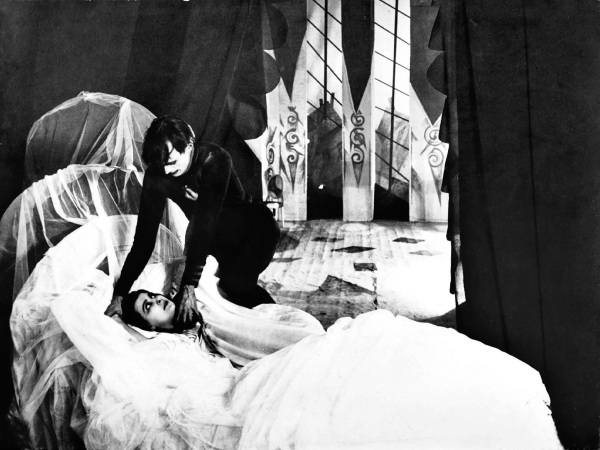
The son of a Methodist Minister and an unapologetic Socialist, Ward produced the first wordless graphic novels in the United States. Ward was influenced by the German master, Hans Alexander Mueller (1888-1962), as well as by German expressionism and early silent film classics like The Cabinet of Dr. Caligari (1920). Ward achieved instant notoriety for his God’s Man: A Novel In Woodcuts, a wordless critique of the deplorable influence of Capitalism on artistic integrity published just as the Great Depression hit America in 1929.
The following year, Lynd Ward published a second graphic novel, Mad Man’s Drum, which followed the tragic history of the familial descendants of a slave-trader cursed by his theft of an African drum.
Following the presentations, Professor Heller-Greenman was kind enough to loan me a copy of an informative documentary film, O Brother Man: The Art and Life of Lynd Ward.
The library (and current exhibit) also features the work of Giacomo Giuseppe Patri (1898-1978), an Italian-American from San Francisco who created a graphic novel to advocate for blue and white collar worker solidarity during the Great Depression.
He lent his artistic talents in support of leftist politics and the militant CIO unions fighting for the West Coast longshoremen in the 1930s, and to fight international and domestic fascism in the 1940s.
GIFT OF FRANCIS XAVIER LUCA AND CLARA HELENA PALACIO LUCA
In the post-war period, Patri continued to show his support for leftist political movements by contributing an illustration to The Communist Manifesto in Pictures.
PROMISED GIFT OF MITCHELL WOLFSON, JR.
Of course, the guest speaker is most known for his comic book illustrations, and the library does have some materials along those lines. While Calero’s work centers on mythic superheroes and villains, one comic book recently donated to the collection dating from the Second World War focused on real-life Allied heroes and Axis enemies.
GIFT OF FRANCIS XAVIER LUCA AND CLARA HELENA PALACIO LUCA
Another WWII era comic book, a promised gift of museum founder Mitchell Wolfson, Jr., uses the image of the classic Superman character, but simultaneously reinforces the message that it is the patriotic efforts of regular war-bond buying Americans that were really responsible for defeating the Japanese war-leader Hideki Tōjō (1884–1948).
Today’s blog post comes to you courtesy of Library Assistant, Michel Potop. Raised in France, Mr. Potop earned a Master’s Degree in History at Florida International University and has been working at the Wolfsonian library helping us to process, catalog, and digitize our expanding collection of rare French materials. Here is his report:
Recently I had the privilege to process a number of items recently purchased in Europe by Wolfsonian museum founder, Mitchell Wolfson, Jr. and deposited with us as a promised gift. Many of these items (and others previously collected and donated to the museum) deal with France during the period of the German occupation. This week I thought that I would share with our readers some interesting examples of primary sources from a particularly dark time in the history of France—the National Revoluti0n imposed by the Vichy Regime.
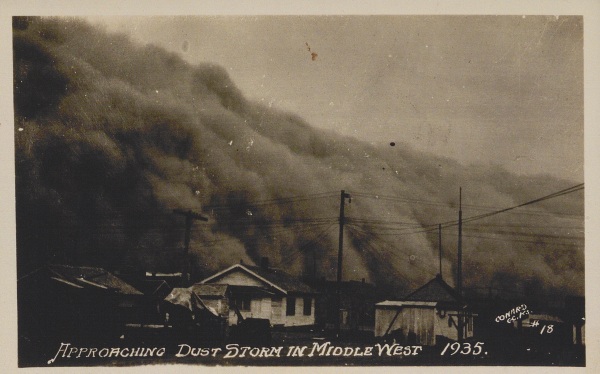
After the crushing defeat that Anglo-French forces suffered at the hands of Nazi Germany in the early stages of the Second World War, France’s Third Republic came to an end. On 1940, France became divided in two diametrically opposed ideological entities: Free-France, under General De Gaulle, and collaborationist Vichy-France, controlled by the Maréchal Philippe Pétain. The nation was essentially divided into two major zones: the occupied and the free zones.
Courtesy of Média Larousse, La France sous Vichy
General De Gaulle and Maréchal Pétain’s forces collided on numerous fronts. In the Metropole, the Resistance fought against the Vichy militia and the occupation armies, while in the colonies, Franco-Allied and Franco-Axis aligned forces engaged in open warfare. The Vichy loyalist army routed the Free France Forces in Dakar in September, 1940, while in Syria (a former French mandate retaining French troops) the Allies routed the Axis armies between June and July, 1941.
In order to legitimize its rule and strengthen its position at home, the Vichy Government instituted a National Revolution under the credo: “Travail, Famille, Patrie” (or, “Work, Family, Country”).
The Vichy political agenda called for the rejection of constitutional separation of powers, the encouragement of traditional values, and the establishment of a personality cult around the figure of Maréchal Pétain.
Lauded as the “Savior of Verdun,” the Vichy government turned Pétain’s popularity as a WWI hero into a cult of the leader to ensure the loyalty of the civilian population and the French troops.
Events were staged so that the “Savior of Verdun” could be photographed honoring veterans for their service.
Pétain was used by Vichy as a figurehead and touted as the only legitimate international spokesman for France.
Interestingly, in some of the Vichy propaganda appealing to the masses the French tricolor flag was not modified or marked by the Vichy symbolism; more typically, however, the new Frankish axe with seven marshal stars is omnipresent in their publications.
The National Revolution emphasized the need for a return to a traditional, patriarchal society framed on strict hierarchy and dominated by a moral order and patriotism.
The Vichy regime stigmatized the Republican government as being responsible for their military collapse at the start of the war. According to Vichy, the defeat inflicted by the Nazis was the result of the moral degradation of the “French society” that had distanced the nation from traditional values. Pétain sought to impose a program designed to ensure the survival of the French nation by reviving and promoting traditional values. Abortion was prohibited, stay-at-home wives rewarded, mothers raising large families decorated, and agricultural work glorified.
MITCHELL WOLFSON, JR. LONG-TERM LOANS
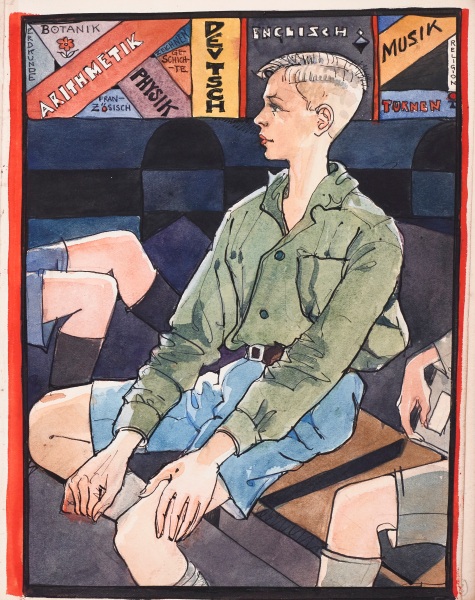
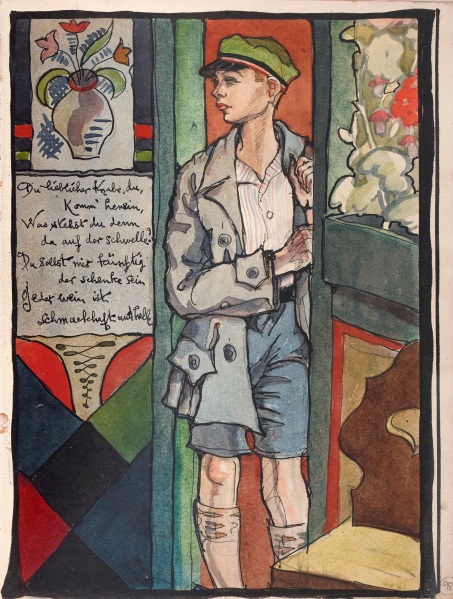
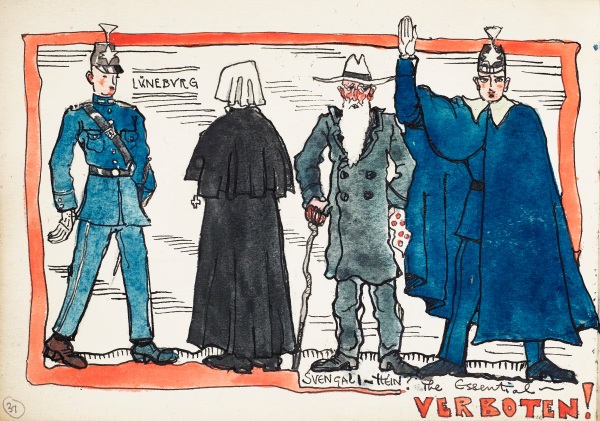
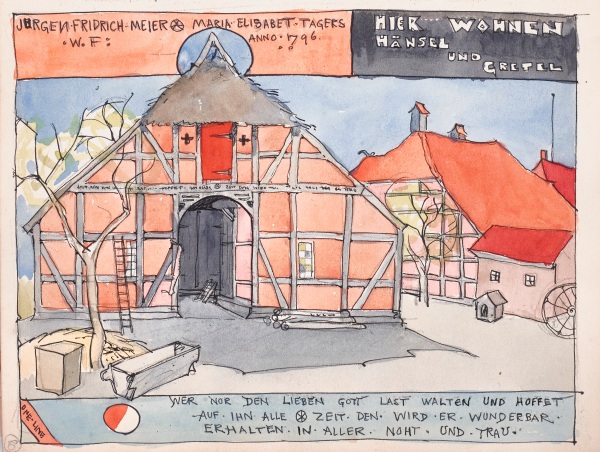
A large portion of the Vichy government’s propaganda efforts were directed at France’s young people.
MITCHELL WOLFSON, JR. LONG-TERM LOANS
A promised gift of Mr. Wolfson includes a number of flashcards that depicted Vichy’s vision of the National Revolution. The cards were meant to explain to the French youth the moral values of the regime and vices to be avoided.
From the “Providential man of Verdun” to the “Traitor of Vichy,” Pétain left an indeliblemark on the political and military history of 20th century Europe. Whether he is seen as a patriot (who despite his advanced age did his best to preserve his vision of France) or a Nazi collaborator who betrayed la Patrie, for better or worse Philippe Pétain remains anchored to Verdun and Vichy, two tragedies that continue to haunt France.
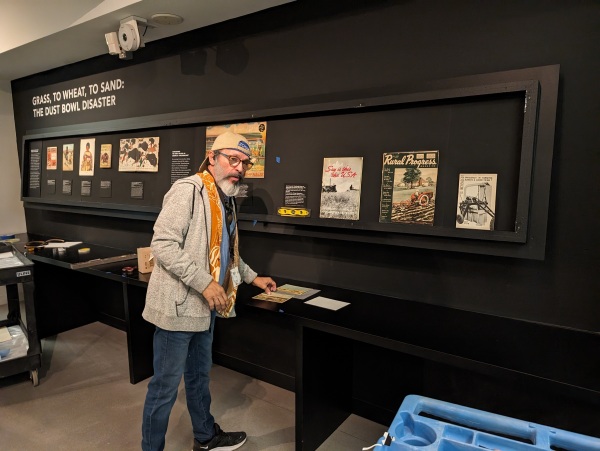
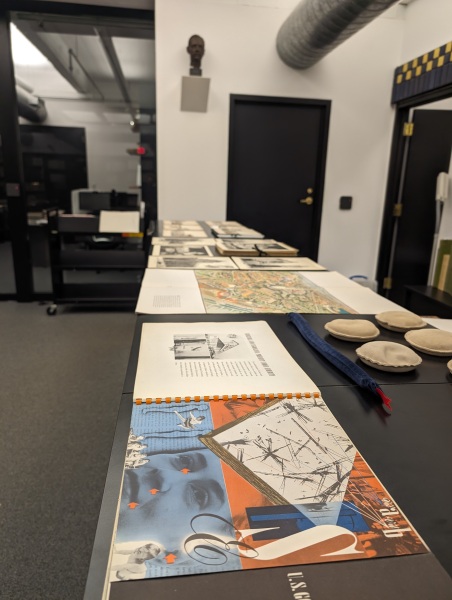
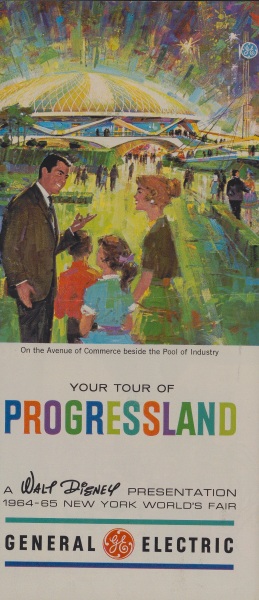
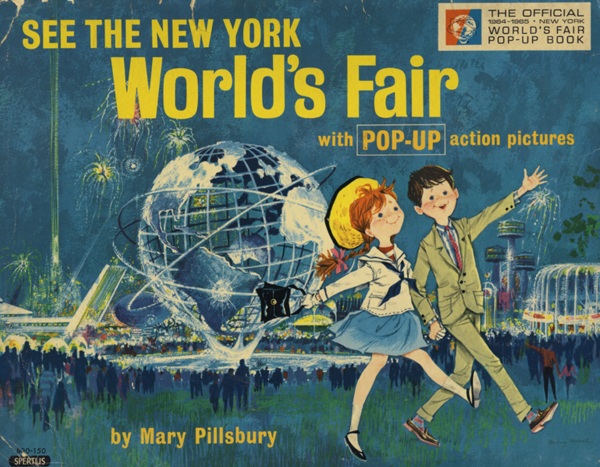
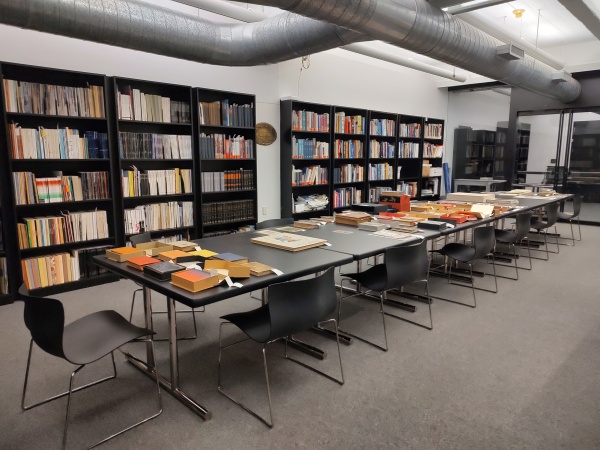
Last week the librarians here at the Wolfsonian-Florida International University had the pleasure of looking over a large body of world’s fair materials originally collected by museum founder, Mitchell Wolfson, Jr. On Wednesday, Associate Librarian Dr. Harsanyi and I gathered and laid out an informal display of 1939 New York World’s Fair materials for a visit by FIU School of Architecture Professor Elysse Newman and her class. Professor Newman is currently teaching a course titled: “Space, Society and the Digital,” and she had specifically requested a few early international exhibition items and a large number of New York World’s Fair brochures, mechanical works, and other ephemera for her class to examine.
One such item was The New York 1939 official World’s Fair pictorial map created by Tony Sarg (1880-1942).
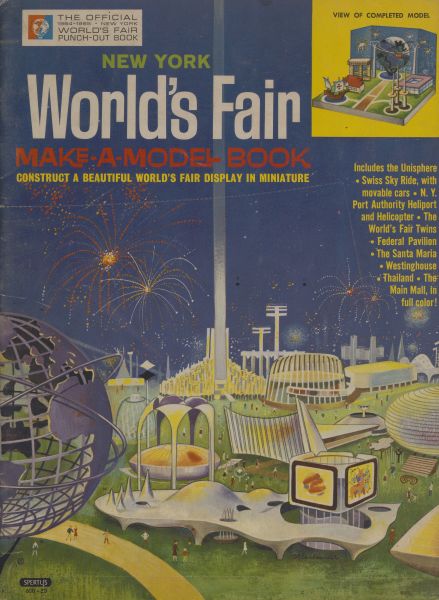
We also took the initiative of pulling a few other items not on the professor’s list, including a world’s fair model which invited the purchaser to build a paper and cardboard replica of the central buildings of the 1939 New York World’s Fair.
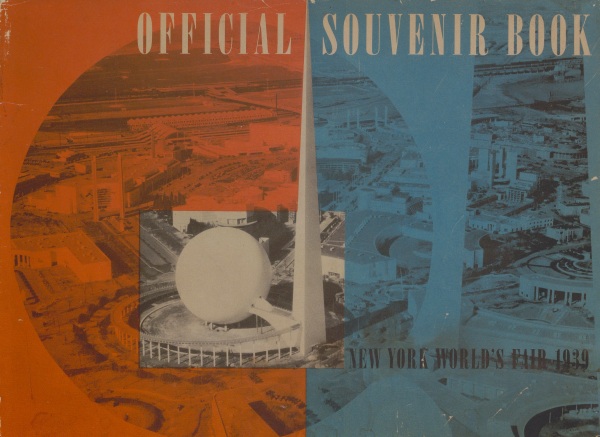
One of the more popular attractions at the 1939 NYWF was an exhibit housed inside a gigantic “perisphere” that, inseparably coupled with a monumental “trylon,” became a ubiquitous icon used to promote the fair.
GIFT OF FRANCIS XAVIER LUCA AND CLARA HELENA PALACIO-DE LUCA
As spectators wormed their way up the ramp to enter this 200 foot diameter spherical edifice, they stepped onto one of two twin rotating balconies from which they could look down onto a model “Democracity”—a “perfectly integrated garden city of tomorrow”—as it would have appeared from an aircraft hovering seven thousand feet above. A brochure with a cover design by Leslie Regan nicely captures the perspective the exhibit was intended to provide its patrons of the clean futuristic city of 2039.
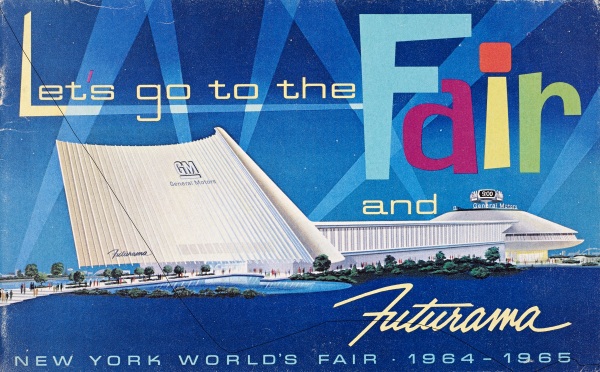
Even more popular, however, was the General Motors “Futurama” exhibition housed in their Highways and Horizon’s building.
Designed by Norman Bel Geddes and constructed under the direction of George Wittbold, this exhibit seated spectators in 552 chairs mounted on a moving conveyor belt designed to carry them over an ambitious “1960s” cityscape occupying a 35,000 square foot space.
Another item that caught the interest of the visiting FIU students was a souvenir telescoping peep show, which, unfortunately, could not be displayed open due to its fragile state.
Ironically, another of these viewers purchased more recently by Mr. Wolfson was on display in downtown Miami at an exhibition housed in the New World School of the Arts Gallery. Here the mechanical work was mounted in such a manner as to provide the gallery visitors with the extended three-dimensional perspective.
Curator/collections manager Lea Nickless has opened the Mitchell Wolfson Jr. Study Centre to Miami Dade College faculty and students and allowed them to select and curate exhibitions using those materials.
Just this last Friday, Dr. Harsanyi, myself, and several other Wolfsonian museum curators and staffers crossed the bay to attend the opening of “Entrances and Exits: Resonating Impressions of World’s Fairs” an exhibition curated by Miami Dade students Luna Lopez and Maggie Genova-Cordovi and collaboratively designed by Chris Ingalls, Danilo A. Mantilla, and Inez Barlatier. Other Miami Dade College and New World School of the Arts contributors include, graphic designers: Amparo Baquerizas, Anthony Quintana, Jessica Martin, and Rebecca Flor; and marketing and communications consultants: Anika Batista, Katie Lynn Acosta, and Veronika Lugo. The show was assembled exclusively from rare objects and artifacts collected by Mr. Wolfson over the course of the last sixteen years, and the items perfectly complement—(and purposely add to strengths and fill in gaps)— the items that he donated to Florida International University in July 1997 as the basis of the Wolfsonian museum collection.
As I often teach a course on the Great Depression and New Deal era for the History Department at FIU, I was particularly pleased to see a couple of works on some of the fairs designed to stimulate local economies and to address urban unemployment by putting engineers, architects, construction workers, and concession operators back to work. One of them features the vibrantly colored modernist exhibition buildings constructed for Chicago’s Century of Progress International Exposition held in 1933 and 1934.
Another more somber oil painting of the 1939 New York World’s Fair reduced the “World of Tomorrow,” to a diminutive, distant dream, barely noticeable in a larger landscape of defoliated tress, industrial smokestacks, and Hooverville shacks.
DETAIL FROM PAINTING
One pictorial map of the World’s Columbian Exposition held in Chicago in 1893, for example, prominently pictures the Manufactures and Liberal Arts Building.
This edifice built by the George B. Post architectural firm could boast of being the largest building in the world for its time—until another firm quickly topped in typical architectural one-upmanship. It is also an important item for our own collection in that The Wolfsonian holds the firm’s beaux arts reference library, the first significant outside donation made to the rare book library after the museum opened to the public in November 1995.
DETAIL OF MAP
The opening night exhibit downtown dazzled the veritable flood of visitors with all sorts of paintings, posters, design drawings, souvenirs, and memorabilia.
The exhibit included works of art from the first world’s fair—the so-called Crystal Palace exhibition held in London in 1851—to the international expositions held in the late 20th and early 21st century.
I was drawn to a souvenir handkerchief which I immediately recognized as having been designed by Tony Sarg—the same artist responsible for the pictorial map we had put on display for FIU students earlier in the week.
Other 3-D items on view in the exhibit were some pristine examples of pop-up views from the 1893 World’s Columbian Exposition in Chicago, Illinois I had never before seen.
There were also some stunning accordion-style view books and miniature books from other fairs on display.
The exhibition is free and open to the public Tuesdays through Fridays from 12:00 noon to 5:00 PM, from April 11 to May 31 2013 at the New World School of the Arts Gallery, located at 25 NE 2nd Street. I heartily recommend local Miamians to avail themselves of the opportunity.
For today’s blog post, I am turning over the reins to Associate Librarian Rochelle Pienn, who has decided to write on a timely news subject. Korea is very much on people’s minds today as the Communist government in Pyongyang has once again reverted to saber-rattling—or would that be missile pointing in the nuclear age! Thanks to the generosity of Jean S. and Frederic A. Sharf, the Wolfsonian library now holds an important collection of materials dealing with Korea’s earlier history. What follows is her report.
Earlier this month, Supreme Leader of North Korea Kim Jong-un declared his intent to restart nuclear facilities. He also decided to withdraw his cooperation from decades-old anti-aggression agreements. Finally, Kim Jong-un adhered to anti-American sentiment in spite of his new friendship with former Chicago Bulls basketball player Dennis Rodman.
Photo courtesy of Jason Mojica, AP Photo/ VICE Media
On the other side of the border, a South Korean figure skater, Kim Yu-na, won the 2013 World’s Figure Skating Championship. She remains the sole Korean to ever earn gold medals in the sport.
Photo courtesy of Darron Cummings, AP Photo.
The whole of North and South Korea lies in-between Japan and China, one of the most sought after strategic locations on Earth. Recent events have brought these deeply divided areas to the forefront of national and global attention. What used to be called “The Land of the Morning Calm” now exists as two countries, moving missiles into position against one another.
The turn of the nineteenth century also proved to be one of constant unrest for Korea. The Jean S. and Frederic A. Sharf Collection in the Wolfsonian-FIU library contains rare books that focus on the Sino-Japanese and Russo-Japanese wars, in which the settlement and possession of Korea was contested among the superpowers.
W. R. Carles’s Life in Corea, published in 1888, has a gilt-stamped illustration of a band of Korean musicians on its front cover. The book emphasizes the bucolic nature of the country and the unique character of its people.
GIFT OF JEAN S. AND FREDERIC A. SHARF
In the 1895 British imprint, Advance Japan: A Nation Thoroughly in Earnest, author J. Morris discusses the immediate impact of the Sino-Japanese War of 1894-95, and Japan’s imperative to reform Korea after the defeat of China.
GIFT OF JEAN S. AND FREDERIC A. SHARF
Japan and Korea were portrayed as countries with potential to modernize and industrialize in a manner palatable to the West, unlike China.
The Russo-Japanese War of 1904-1905 came about as a result of Russia’s desire to invade Korea and Manchuria for the purpose of taking over critical trade routes. Japan once again ousted its aggressor and surprised the Western powers with its ability to win wars over much larger and seemingly more resourceful enemies.
GIFT OF JEAN S. AND FREDERIC A. SHARF
From Tokyo to Tiflis: Uncensored letters from the War, written by Daily Mail reporter Frederick Arthur McKenzie and published in 1905, contains a detailed map of Yalu. This Korean-Chinese border river is where the first major battle of the Russo-Japanese War took place. It ended with a decisive Japanese victory.
GIFT OF JEAN S. AND FREDERIC A. SHARF
In 1907, George Heber Jones, president of the Biblical Institute of Korea, wrote Korea: the Land, People, and Customs. The slim volume was meant to be a basic guide to the foreign culture for Methodist Episcopal missionaries intent on converting Koreans to Christianity.
GIFT OF JEAN S. AND FREDERIC A. SHARF
Missionary activity in the Far East peaked during the colonial era. From the 1880s through the early 1900s, Christians from the United States and Great Britain traveled to Korea in order to bring the New Testament to natives. The description and travel narratives produced by missionaries provide overviews of Korean history, culture, dress, and religious practices.
GIFT OF JEAN S. AND FREDERIC A. SHARF
A general fascination with the Orient became amplified as imperial colonialism and regional warfare continued. Those with means would voyage to Korea and publish their experiences for popular consumption. This Korea entry of the book series Peeps at Many Lands by Constance J. D. Coulson gives an educated, independent British woman’s opinion of life in Korea. The author expresses pity for what she sees as the endless drudgery and perceived slave-like role of the Korean female. Edward H. Fitchew, a prolific nineteenth century British painter, contributed color illustrations.
GIFT OF JEAN S. AND FREDERIC A. SHARF
In contrast to what would have been possible in Ms. Coulson’s lifetime, now in the 21st century a young Korean woman has risen to the top of her sport, making history.